
EXPLORING THE FUTURE OF INTELLIGENT MANUFACTURING
From intelligent machining and flexible automation to AI-driven manufacturing, the ninth edition of the Symposium on Automation & Robotics, organized by the Indian Machine Tool Manufacturers’ Association (IMTMA) at the Bangalore International Exhibition Centre (BIEC), explored the technologies, strategies, and organizational shifts shaping the next phase of industrial production.
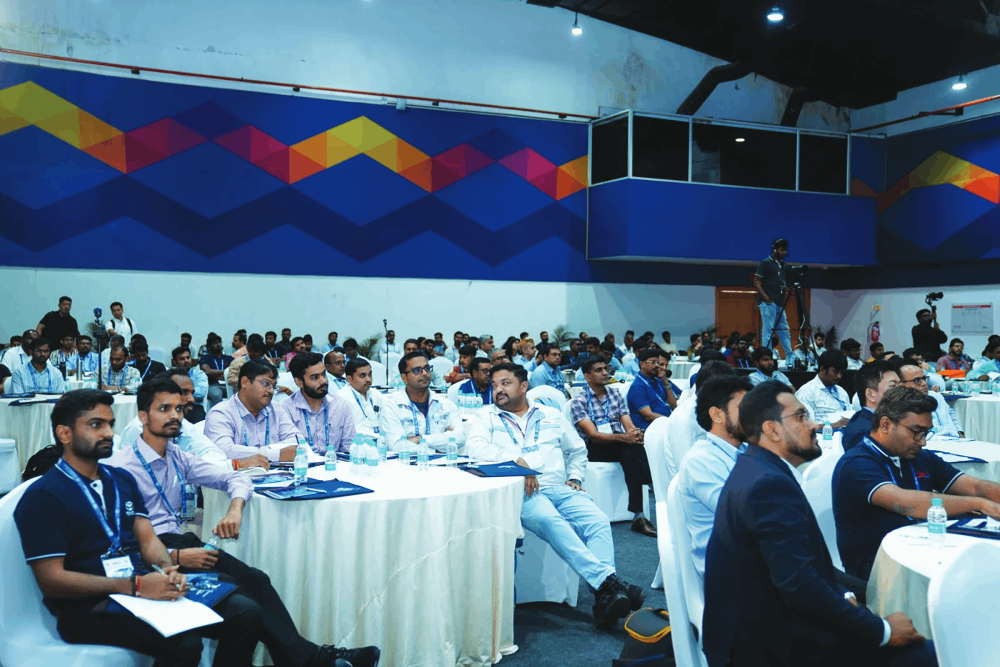
Spanning two days, the conference and concurrent exhibition brought together over 250 delegates, 750 trade visitors, and more than 30 pioneering solution providers to explore the future of intelligent manufacturing.
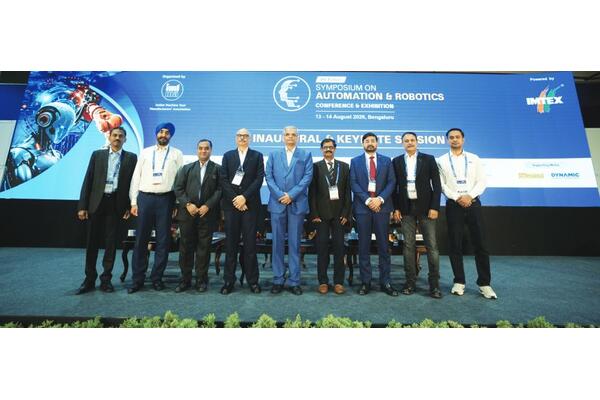
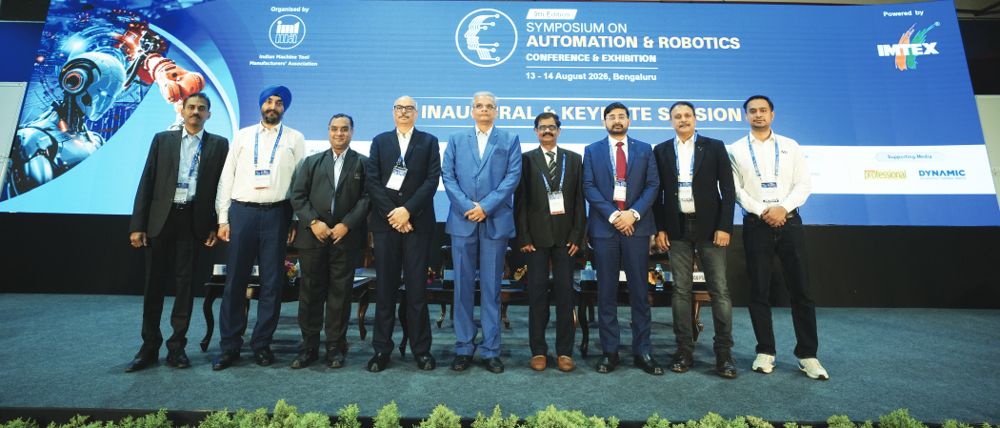
The inaugural ceremony was graced by Dr Ravi Guttal, CTO, Aequs Ltd; V Sriram Kumar, CEO, ELCIA; and Sundariya S, Chairman, IMTMA Regional Council South. Jibak Dasgupta, Director General & CEO, IMTMA, was also present at the inauguration.
Setting a forward-looking tone, Guttal emphasized that long-term industrial competitiveness hinges on evolving core MES data into autonomous AI agents, urging manufacturers to invest in robust MES architectures to ensure AI is truly fit-for-purpose. Reinforcing the strategic imperative, Kumar, in his address, called on the Indian machine tool industry to transition from merely building capacity to establishing domestic IP, local design, and rigorous R&D powered by smart robotics.
Engineering Fundamentals,
Global Shifts & Organizational Readiness
Day 1 focused on the foundational disciplines required to transition from manual operations to self-correcting, intelligent production.
Beginning with the foundational enablers, Ramesh Ramachandar (Festo) underscored that safety architecture, energy-efficient pneumatics, and open connectivity must be engineered upfront rather than retrofitted.
The discussions then turned to global supply chain realities. In two fireside chats moderated by Nishant Kashyap, BP Shiv (TAFE) and Vidyadhar J (Sansera Engineering) discussed how precision automation builds the process consistency required for Indian discrete manufacturers to capitalize on the ‘China+1’ shift.
The symposium also explored intelligent machining and capacity, Upendra Vanarase (TRIO Motion) highlighted the necessity of building intelligence on rigid mechanical baselines. Adding to this, Ashwin Udayashankar (SCHUNK Intec) discussed smart automation, enabling flexible and future-ready manufacturing, while Tatsuya Matsuda (Mitsubishi Electric) addressed maximizing spindle utilization through robotic loading.
The human dimension of automation was subsequently addressed in the session on building an automation-ready organization. Moderated by Chandrashekar Bharathi (AceMicromatic MIT), the leadership panel brought together D Uma Maheshwar (GE Aerospace Engineering Center), Dr Vishwas Puttige (amace Solutions), Thej Kumar (Toyoda Gosei South India), and Dr Naveen Arulselvan (ATI Robotics). The panelists examined why technically sound projects often stall without proper change management, workforce upskilling, and organizational governance aligned with new shop-floor technologies.
Scalability, Brownfield Integration & Financial Justification
Building on the discussions of Day 1, Day 2 pivoted towards practical execution, scalability, and economic viability.
Opening the day, the keynote by Ajay Gopalaswamy (DiFACTO Robotics) presented a blueprint for elevating India from a systems integrator to a global robotics product powerhouse.
The symposium then turned to flexible and brownfield execution. Anuj Bihani (Alstrut India) demonstrated how modular cell designs absorb shifting product variants, while Sandeep Shetty (Toyota Kirloskar Auto Parts) presented a case study on retrofitting legacy machines with robotics, safety recertification, and signal extraction.
Moving from individual applications to enterprise-wide adoption, George Rajan (Honeywell Aerospace) outlined governance frameworks to scale pilot cells plant-wide. MR Seetharam (Synthesis Winding / ELCIA) analyzed national adoption trends, while Srinivas P Kamisetty (Kabelschlepp) detailed the uptime value of critical motion infrastructure.
The symposium concluded its conference sessions with a focus on automation ROI and financial confidence. Moderated by V Jagannath, EVP & COO, M2NXT, the closing panel featured Upendra Vanarase (TRIO Motion Technology), Mahendra Patil (FANUC India), Ranjan Singh Chadha (Festo), Mushtaq Jamal (Bevel Gears India), and Ashwin Udayashankar (SCHUNK Intec India). The panelists dismantled traditional skill-displacement metrics, providing frameworks to assess total cost of ownership (TCO), identify hidden operational costs, and establish realistic payback timelines that secure boardroom and finance approvals for automation investments.
Concurrent Exhibition & Strategic Takeaway
Complementing the conference, the concurrent exhibition provided attendees with hands-on access to live demonstrations from over 30 leading robotics and automation providers.
Together, the two-day symposium and exhibition provided a platform for industry stakeholders to examine the engineering, organizational, technological, and financial considerations shaping the adoption of intelligent manufacturing. The discussions highlighted the need for robust technological foundations, workforce readiness, scalable solutions, and clear financial justification as manufacturers move towards increasingly automated and intelligent production environments.
Source: IMTMA
 Facebook
.png) Twitter
 Linkedin
 Subscribe