
Turning Loose Chips into Manageable Value
Every machining shop eventually runs into the same quiet problem. Turning, milling, and drilling operations generate a steady stream of metal chips and swarf. That stream never really stops; it just piles up. For aluminum die-casting and machining facilities running multiple shifts, the volume of loose chips accumulating around machines and in bins can become a genuine operational headache, one that has less to do with the casting process itself and more to do with what happens after the metal is cut.
Loose chips are bulkier than they need to be. A given weight of machined aluminum, once cut into chips, occupies far more floor and storage space than the same metal in solid form. That space is rarely free; it competes with staging areas, tooling, and material movement. Handling loose chips is also inherently messy: they carry residual cutting fluid with them, which means bins of chips are effectively bins of wet, oily scrap. This makes transportation heavier, storage less hygienic, and scrap yards harder to keep organized. It also means a portion of the coolant a plant has already paid for leaves the building inside the scrap bin, never to be used again.
None of this is a failure of the machining process; it is simply what happens when chip handling is treated as an afterthought rather than a process in its own right. As pressure grows to improve housekeeping, reduce material loss, and manage resources more deliberately, loose chip handling remains one of the more overlooked areas left to fix.
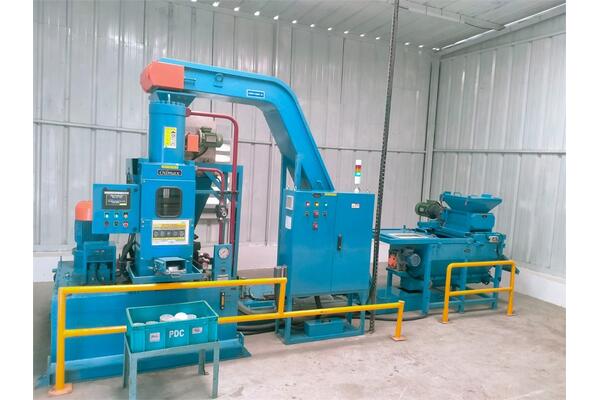
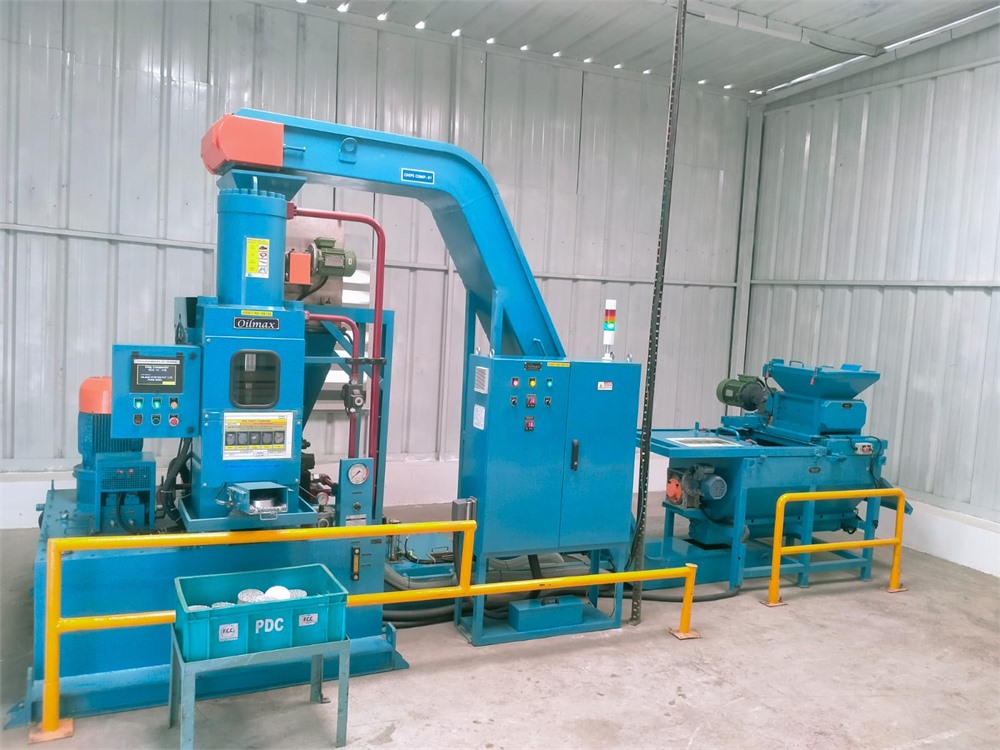
This is the issue the Oilmax Chip Compactor is built to address. The principle is straightforward: loose metal chips are fed into the compactor, where they are compressed into dense, manageable briquettes. As the chips are compressed, excess coolant trapped within them is squeezed out and separated, allowing it to be collected for potential reuse within the plant. What enters as loose, wet, bulky chips leaves as two distinct, usable outputs: compact metal briquettes and recovered coolant.
The benefits of this transformation are practical rather than dramatic, but they add up across a shift and across a plant. Briquetted chips take up a fraction of the space occupied by loose chips, easing pressure on storage and staging areas. They are easier and safer to handle and move, reducing the transportation effort tied to scrap. Because coolant is separated during compaction, less fluid is lost with the scrap, and what is recovered can potentially be reused. The shop floor benefits too — less loose, oily chip material generally means better housekeeping and a cleaner, safer environment.
Seen in isolation, chip compaction might look like a small step. Seen against a plant's broader goals, it fits into the push toward better resource recovery, greater operational efficiency, and more sustainable shop-floor practices. Oilmax Systems Pvt Ltd has built its work around exactly this kind of practical fluid and chip management for modern manufacturing facilities.
 Facebook
.png) Twitter
 Linkedin
 Subscribe