
THE IMPORTANT ROLE OF SYSTEM INTEGRATION IN LASER WELDING AND HARDENING APPLICATIONS
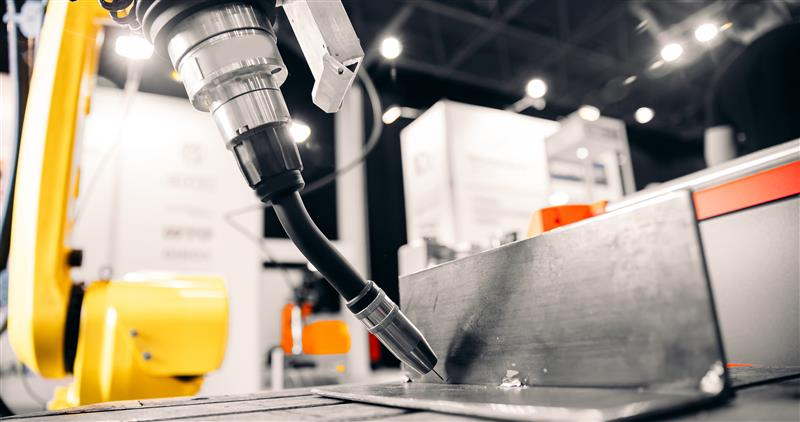
The increased adoption of advanced laser technologies by manufacturing industries has led to higher complexity of systems used in welding and surface hardening applications. Successful laser processing mostly depends on advanced integration techniques needing expert system integrators, even though the lasers have gained power and reliability.
Laser welding and hardening operations in modern industry are more than just basic beam application to workpieces. Industrial applications at present require a seamless integration of laser sources with suitable beam delivery optics as well as motion control systems. Additionally, process monitoring sensors, safety interlocks and other quality assurance mechanisms like vision is necessary. All these system components need to operate as one harmonious unit to achieve the precision, repeatability, and efficiency requirements of modern manufacturing operations.
This demands the successful integration of different technological elements beyond individual component functionality. The delivery of exceptional beam quality by high-powered fiber lasers requires seamless integration with motion control systems, thermal management as well as process monitoring systems to realize their full potential. Project success now depends heavily on laser integration expertise, which has become the key factor influencing outcomes.
Core Integration Challengesin Laser Processing
Beam Delivery and Optics Management
Optimizing beam delivery systems represents the first essential step for effective laser integration in industrial requirements. Selecting appropriate focusing optics together with beam shaping elements, protective windows, etc., form the foundation for successful welding operations in industrial environments. Beam homogenization together with precise energy distribution plays a crucial role in hardening applications.
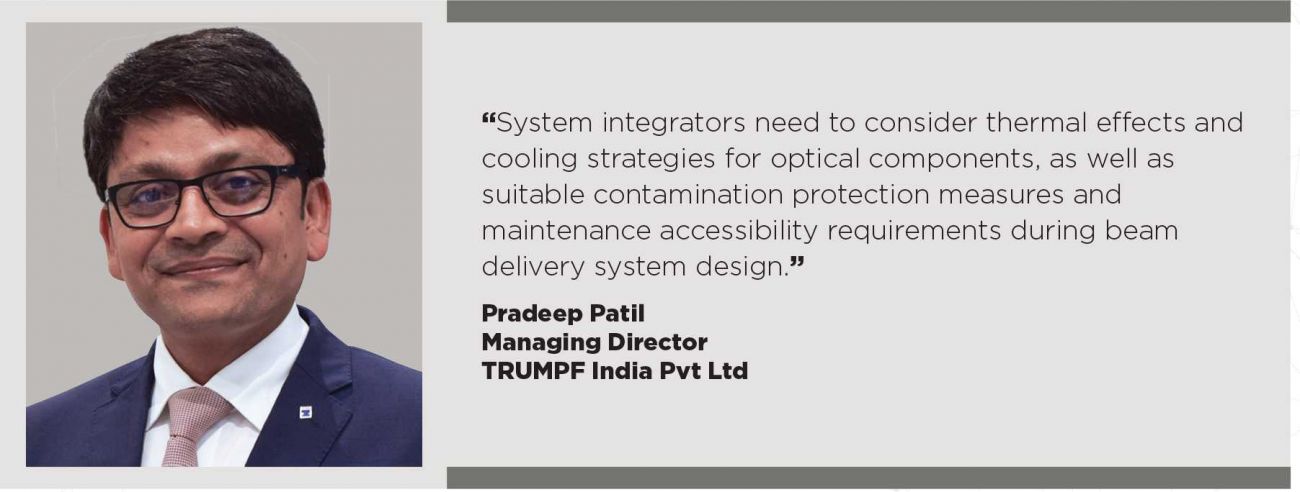
Pradeep Patil, Managing Director, TRUMPF India, says, “System integrators need to consider thermal effects and cooling strategies for optical components, as well as suitable contamination protection measures and maintenance accessibility requirements during beam delivery system design. The integration challenge involves maintaining consistent beam quality during robotic applications where the laser head navigates complex three-dimensional paths and operates at different working distances and angles.”
| Selecting appropriate focusing optics together with beam shaping elements, protective windows, etc., form the foundation for successful welding operations in industrial environments. |
Motion Control Synchronization
System integration expertise becomes most crucial when aligning laser output with motion control systems. Modern laser welding and hardening require synchronized operation between laser power modulation and robot travel speed/positioning accuracy. Any change in these process parameters will cause heat input inconsistencies which produce quality defects or lead to unstable process operation.
Advanced integrated solutions implement real-time feedback mechanisms that modify laser settings according to motion system characteristics including acceleration and deceleration patterns and path limitations or mechanical boundaries. A deep understanding of both laser physics and motion control concepts is essential for achieving this level of integration.
Process Monitoring and Adaptive Control
Modern laser integration depends on advanced monitoring systems which provide closed-loop process control functionality. The welding process requires seam tracking, weld depth monitoring, and weld defect detection systems. Real-time temperature monitoring and thermal profile control systems are a must for laser hardening processes to maintain consistent hardening depths.
The main difficulty emerges from processing various data streams at once while executing required control actions within the critical time window of laser processing operations. System integrators need to design architectures that acquire high-speed data while performing real-time analysis and making immediate process corrections without causing system instabilities.
The Strategic Value of Specialized Integrators
Technical Expertise and Application Knowledge
Successful laser integration requires professionals who combine knowledge in laser physics, mechanical engineering, control systems, software development, and manufacturing processes. Integrators use their multiple areas of expertise to foresee production challenges and develop optimized system solutions to surpass component specifications. The main advantage of experienced integrators comes from their extensive knowledge of executing similar systems deployed in various industries. An experienced team understands the impact of welding dissimilar materials on the process, the thermal management requirements for various hardening patterns, and the production environment conditions that influence system reliability.
Risk Mitigation and Project Management
Laser integration projects carry major technical risks together with substantial financial risks if not integrated in the right way. The combination of incompatible components, less experience in possible installation problems, and extended integration phases lead to increased expenses and postponed manufacturing deadlines. The single point of accountability provided by experienced integrators enables them to manage suppliers and coordinate installations while verifying system performance to meet required specifications.
|
System integrators create specialized fixturing for complex geometries, develop custom software algorithms, and also design unique safety systems. This ability to customize operations sets professional integrators apart from basic equipment providers. |
The risk mitigation strategy includes long-term operational aspects. System integrators plan systems that include maintenance-friendly designs and standardized components together with upgradation possibilities that defend the client’s financial investment during the operational period.
Customization and Optimization
Optimal performance requires customized and specific solutions that match client production environments and quality standards beyond what standard laser components offer. System integrators demonstrate exceptional ability to find performance enhancement possibilities and create individualized solutions that deliver the best investment return. They create specialized fixturing for complex geometries while also developing custom software algorithms for process optimization. System integrators also design unique safety systems according to specific operational requirements. The ability to customize operations sets professional integrators apart from basic equipment providers.
Integration Technologies Driving
Innovation Industry 4.0
Integration Modern laser integration systems adopt Industry 4.0 principles by establishing connections to manufacturing execution systems that enable advanced analytics capabilities. System integrators use IoT sensors together with cloud connectivity and machine learning algorithms to continuously optimize process parameters through analysis of historical performance data. IoT component manufacturers can use predictive maintenance approaches along with quality trend monitoring and production efficiency maximization that exceeds laser system capabilities. The implementation of these capabilities demands integration expertise that combines traditional manufacturing systems with modern information technologies.
Artificial Intelligenceand Machine Learning
High-level integrators are currently adding Artificial Intelligence (AI) and machine learning (ML) functionalities into laser control systems. Through these technologies, organizations can establish adaptive process control systems that adjust operational parameters automatically using real-time data and historical information. AI systems used in welding applications can predict material property variations and joint preparation differences as well as environmental changes to provide compensation. ML algorithms used in hardening applications optimize heating patterns and cooling rates to produce uniform metallurgical properties across intricate shapes.
Multi-Laser Coordination
The increase in production volumes and part complexity makes many applications more efficient when multiple laser systems operate in coordinated fashion. The system includes simultaneous welding heads working on extensive assemblies and coordinated hardening systems that process different sections of one component. Controlling multiple laser systems needs advanced control systems to distribute resources and synchronize timing patterns while providing safety functions between system components. The high complexity of integration demands specialized knowledge that only a few organizations have mastered.
Future Trends
Modular Integration
The industry is advancing towards modular integration systems which allow easier reconfiguration and upgrades when production requirements change. The integration process requires designers to establish interfaces and communication standards which allow future updates without needing full system overhaul.
Sustainability
Environmental concerns are gaining rising importance when implementing laser integration projects. The industry has started to use energy recovery systems while optimizing processes to reduce waste heat production and designing systems that use fewer consumables while producing less waste.
Future of Laser Manufacturing
Modern laser welding and hardening projects achieve success through advanced integration approaches that maximize system performance beyond individual component capabilities. The evolution of laser applications toward higher complexity and performance demands makes specialized system integrators increasingly vital for future manufacturing success. Organizations that want to implement laser-based manufacturing must understand that integration expertise functions as a strategic benefit that determines whether a project succeeds or fails. Manufacturers partnering with qualified integrators who understand both the technical and practical aspects of laser processing gain the performance, reliability, and return on investment needed to justify implementing advanced laser technologies.
Reji Varghese is the President of RV Forms and Gears, one of India's oldest fixture building companies.He is also a guest writer for a number of national newspapers and magazines.
 |
REJI VARGHESE |
 Facebook
.png) Twitter
Twitter Linkedin
 Subscribe