
ENGINEERING THE FUTURE WITH DESIGN-LED MANUFACTURING
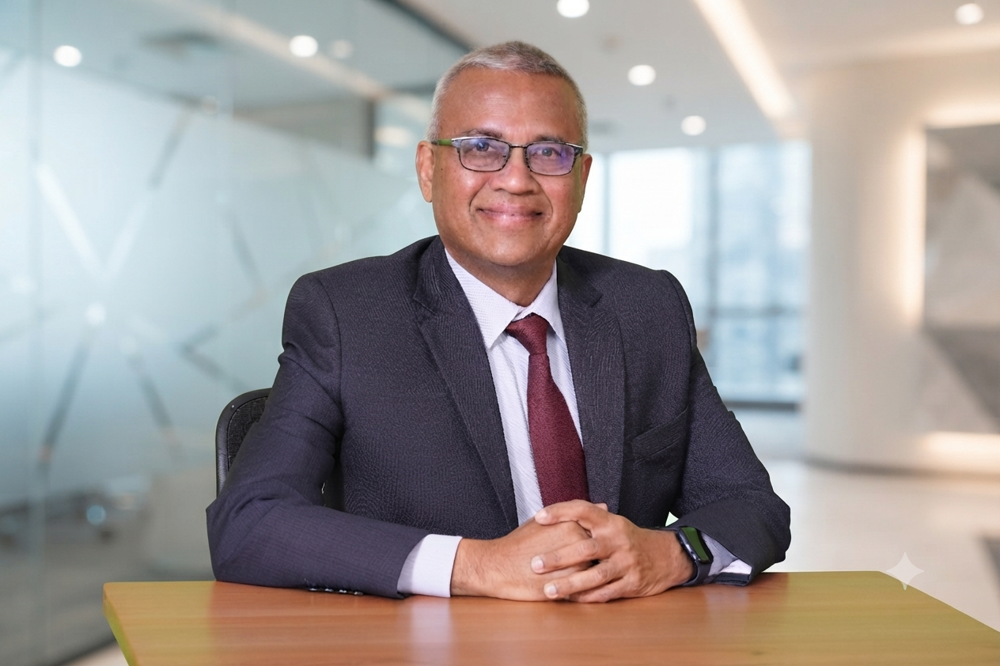
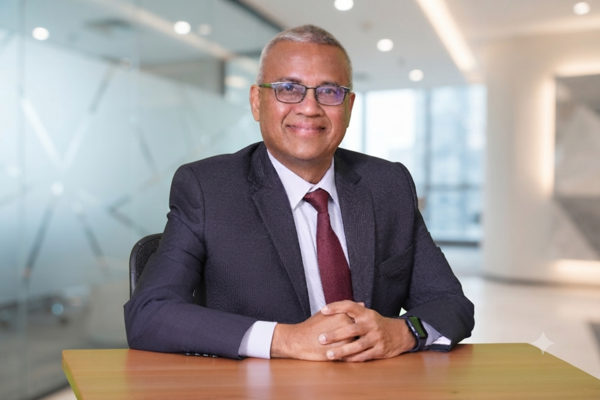
In this exclusive conversation with MMI's Editor-in-Chief Soumi Mitra, Rabindra Srikantan, Founder & Managing Director, ASM Technologies Ltd, discusses the company's transformation from an Engineering Research & Development (ER&D) services provider to a Design-Led Manufacturing (DLM) partner, its expansion plans, the growing role of Industrial AI, and how India
can strengthen its position as a global hub for high-value engineering and advanced manufacturing.
ASM Technologies has success fully transitioned from being a pure Engineering Research and Development (ER&D) service provider to a global leader in Design-Led Manufacturing (DLM). How has this evolution altered your core value proposition for high-tech sectors like semiconductors and aerospace?
Headquartered in Bengaluru, ASM Technologies Ltd is a global ER&D and digital engineering firm. We deliver product design, consulting, and design-led manufacturing services. The company primarily serves the semiconductor, automotive, and solar energy industries. We were established in 1992 and now have a global presence in USA, Singapore, UK, Canada, Mexico and Japan.
As an ER&D provider, ASM was focused on two broad verticals—high-tech capital equipment (semiconductors, electronics and solar) and engineering. We made a conscious decision to pivot to Design-Led Manufacturing (DLM) while continuing to focus on these core verticals. Today, we support our customers across the complete value chain and product lifecycle—from design and engineering to manufacturing—powered by Industrial AI.
With major infrastructure investments underway, including substantial expansion initiatives in Karnataka and Tamil Nadu for Electronic System Design and Manufacturing (ESDM), what specific capacities and technological capabilities are these new facilities designed to unlock?
Our expansion is focused on building world-class manufacturing capabilities for high-precision capital equipment. We have already commissioned three new manufacturing facilities, including one in Vietnam, in addition to our existing operations. We are also setting up a 10-acre integrated Design-Led Manufacturing campus in Karnataka. These facilities will enhance our capacity to support semiconductor, electronics and industrial equipment manufacturing, while strengthening our ability to serve global customers through advanced manufacturing, AI-enabled operations, and scalable production capabilities.
 India's semiconductor landscape is experiencing an unprecedented surge. From your perspective as an industry pioneer, what are the most critical engineering and design gaps that Indian firms must bridge to compete on a global scale?
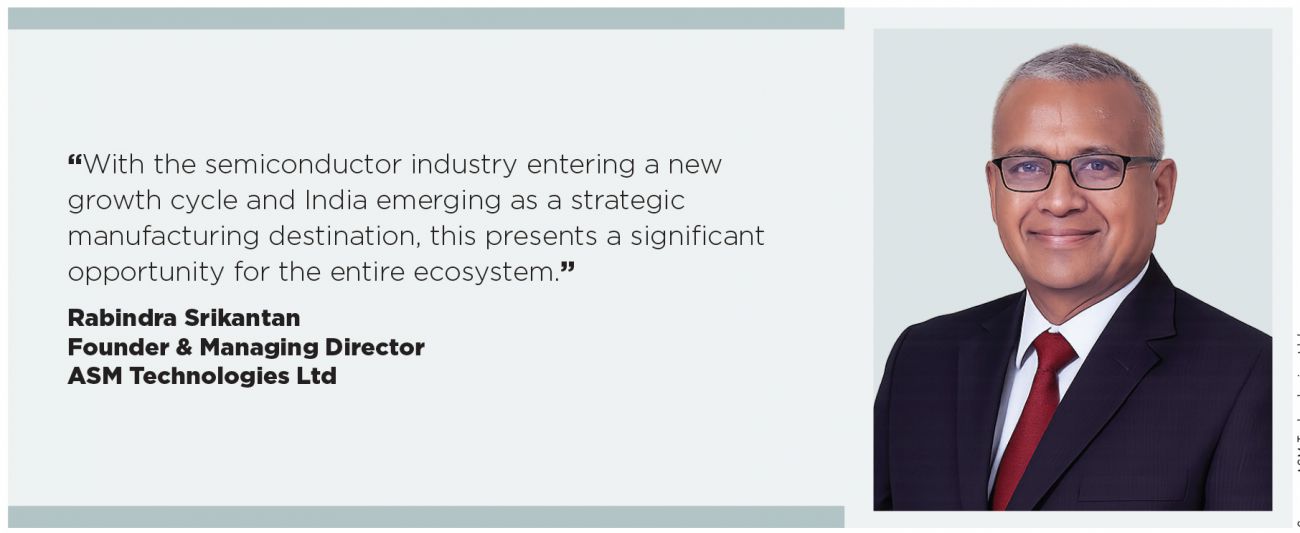
India has already established itself as a global leader in semiconductor chip design, and these capabilities will continue to scale for global markets. With the semiconductor industry entering a new growth cycle and India emerging as a strategic manufacturing destination, this presents a significant opportunity for the entire ecosystem.
To compete globally, Indian companies must strengthen capabilities in advanced engineering skills, talent development, capital equipment, materials, precision manufacturing and supporting infrastructure.
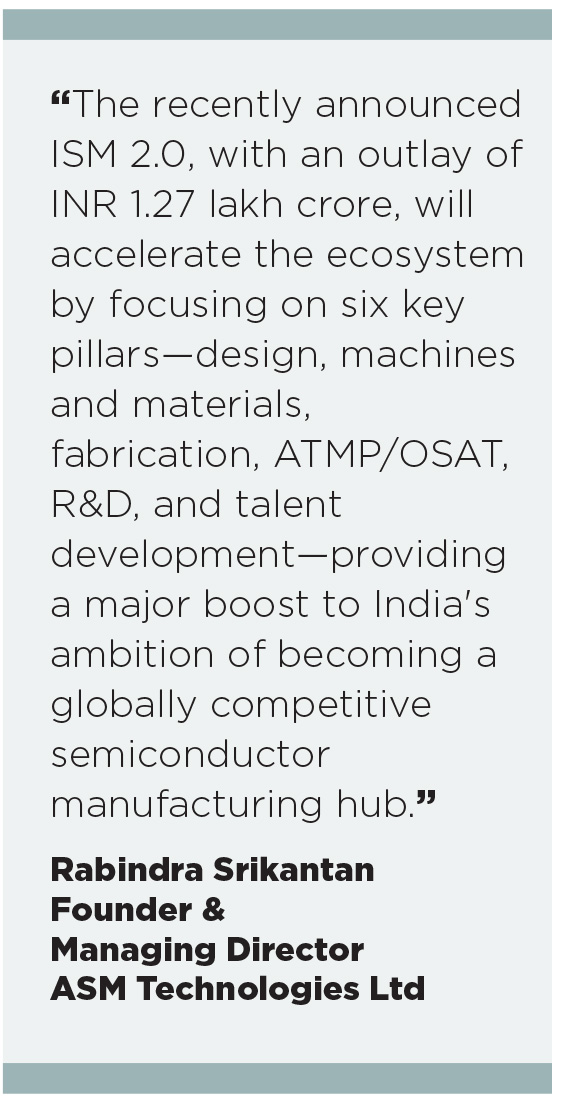
The Government of India’s India Semiconductor Mission (ISM) 1.0 has laid a strong foundation, with 12 approved projects involving investments of over INR 1.64 lakh crore, including three units already in commercial production. The recently announced ISM 2.0, with an outlay of INR 1.27 lakh crore, will further accelerate the ecosystem by focusing on six key pillars—design, machines and materials, fabrication, ATMP/OSAT, R&D, and talent development—providing a major boost to India’s ambition of becoming a globally competitive semiconductor manufacturing hub.
The joint venture between ASM Technologies and Hind High Vacuum (HHV) represents a major step forward for domestic semiconductor equipment manufacturing. Could you share some insights on how this synergy is progressing?
Our joint venture with Hind High Vacuum (HHV) is focused on building indigenous capabilities in advanced manufacturing equipment for India's solar and semiconductor ecosystem.
During FY26, we made significant progress in developing next-generation photovoltaic materials, silicon processing technologies, and specialized manufacturing equipment for solar cell production. We have successfully completed process simulations and engineering validation, while prototype hardware is currently under fabrication. Customer qualification is also underway for specialized intermediate storage and handling systems, with repeat orders already secured.
Looking ahead, we are developing indigenous silicon crystal growth equipment and believe the opportunities under ISM 2.0 will significantly accelerate India's journey towards self-reliance in strategic manufacturing equipment under the 'Make in India' initiative.
Through your subsidiary, RV Forms & Gears, LLP, ASM has driven significant innovation in industrial fixtures with SmartFix 4.0. How are intelligent fixture technologies reshaping the shop floor, and what is the next frontier?
Manufacturing is evolving to wards intelligent, connected and autonomous operations. Across our manufacturing equipment and sub-systems, we are integrating automation, Industrial AI, sensors, IIoT, and advanced analytics to improve precision, productivity, and quality.
At ASM, this transformation is powered by our AI strategy, with AI Assist serving as the foundational intelligence layer that enables engineers and operators to access enterprise knowledge and machine data through natural language. Building on this foundation, Predictive AI, Vision AI, Engineering AI, and Conversational AI, together with our strategic partnership with Myelin Foundry, are enabling AI-native manufacturing equipment. The next frontier is the development of self-optimizing manufacturing systems capable of predictive maintenance, intelligent process control, autonomous decision-making, and continuous learning across the entire production lifecycle.
ASM has built deep expertise in integrating IoT, Virtual Reality (VR/AR), and advanced simulation into product design. How are your clients leveraging these digital tools?
Digital engineering continues to evolve rapidly, and today the focus has expanded beyond traditional technologies such as IoT, VR/AR and simulation to AI-enabled engineering and intelligent manufacturing.
At ASM, we are helping customers leverage AI Assist, Vision AI, Predictive AI, Engineering AI and Conversational AI to transform engineering, manufacturing, and lifecycle support. These technologies enable faster product development, improved design quality, predictive maintenance, enhanced asset performance, and intelligent decision-making.
Combined with our Design-Led Manufacturing approach, they help customers accelerate innovation, improve operational efficiency and build AI-native manufacturing ecosystems that are ready for the future.
With a footprint extending across the US, Europe, Japan and emerging manufacturing hubs like Vietnam, how do you balance global design standards with localized production requirements?
We operate across multiple geographies and adhere to globally recognized certifications and quality standards. While we have our own design standards, we also adapt to customer-specific design requirements to meet local market needs.
We have established manufacturing operations in Vietnam to serve customers across Asia, and we will continue to expand our manufacturing footprint in strategic global locations.
High-precision industries like semiconductor equipment require highly specialized engineering talent. What initiatives is ASM undertaking to cultivate a future-ready workforce?
Talent development is a strategic priority at ASM. We work closely with leading academic institutions to strengthen hiring, skill development, and collaborative research, creating a strong pipeline of future-ready engineers.
At the same time, we continuously invest in upskilling our existing workforce to keep pace with rapidly evolving technologies in semiconductors, Industrial AI, advanced manufacturing, and engineering.
By combining academic partnerships, continuous learning, and hands-on exposure to emerging technologies, we are building a highly skilled workforce capable of delivering next-generation engineering and manufacturing solutions for global markets.
Please share your long-term vision for ASM Technologies' role in shaping India's identity as not just a manufacturing hub, but a global powerhouse for complex, high-value engineering design.
India is well positioned to become a significant player in the global supply chain, particularly in advanced manufacturing, by leveraging its strong engineering and design capabilities alongside the growing demand driven by its expanding economy.
Global companies will increasingly manufacture in India—not only to serve the domestic market but also to supply global markets. ASM Technologies aims to play a pivotal role in this transformation by strengthening India's position as a global hub for high-value engineering, design, and advanced manufacturing.
Source: ASM Technologies Ltd
 |
SOUMI MITRA |
 Facebook
.png) Twitter
Twitter Linkedin
 Subscribe