
BUILDING INDIA’S AEROSPACE EDGE
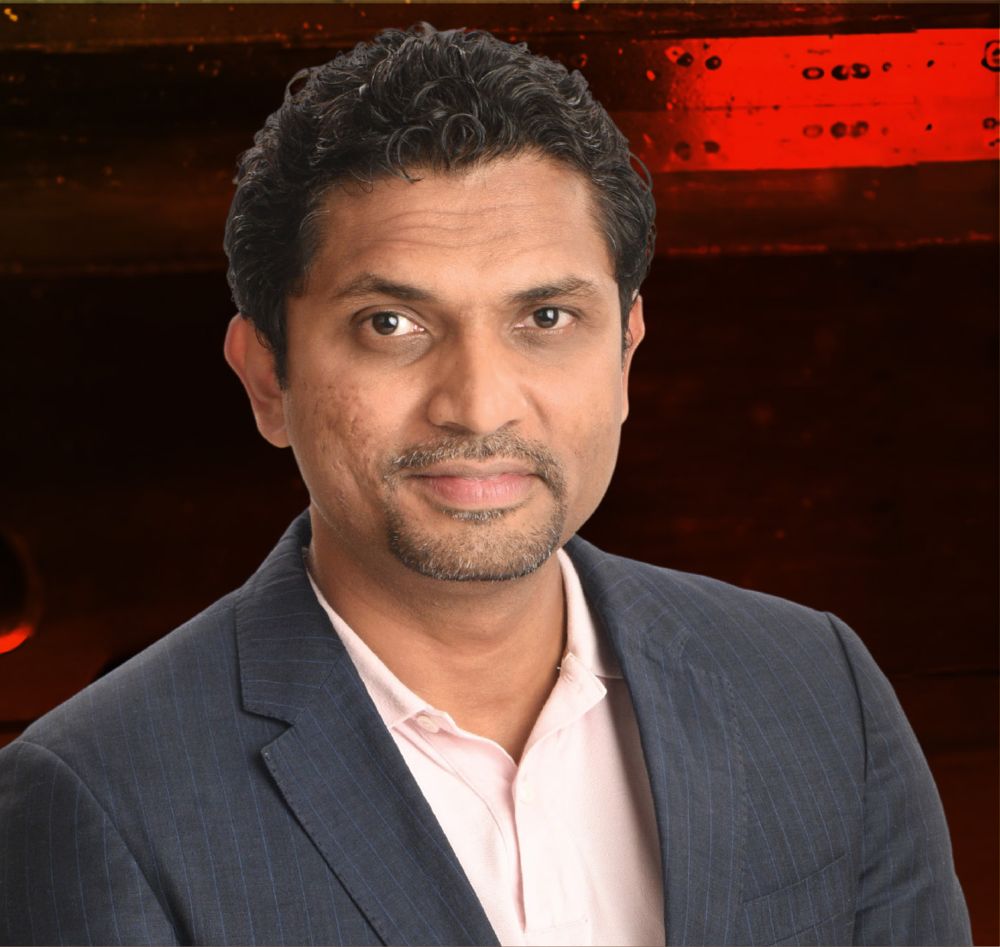
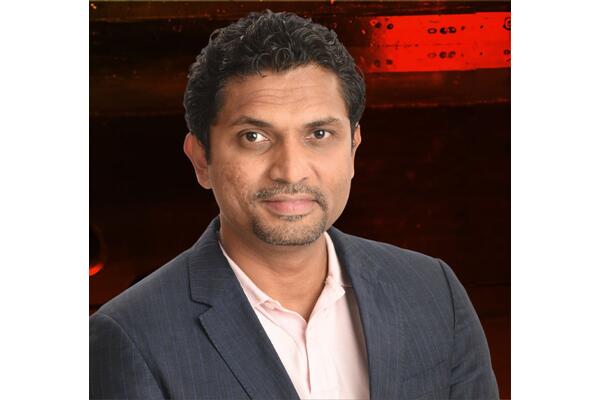
As India strengthens its position as a global aerospace manufacturing hub, Hical Technologies is preparing for its next phase of growth. In the following interview with Soumi Mitra, Editor-in-Chief, Modern Manufacturing India, Yashas Jaiveer, Managing Director, Hical Technologies, shares his perspective on building global customer trust, scaling zero-defect manufacturing, expanding capacity and R&D, and moving the company towards higher-value engineering and complete aerospace systems.
With global OEMs aggressively looking for ‘China+1’ alternatives and reliable geopolitical partners, how is Hical capitalizing on this moment to become a strategic partner for international aerospace giants?
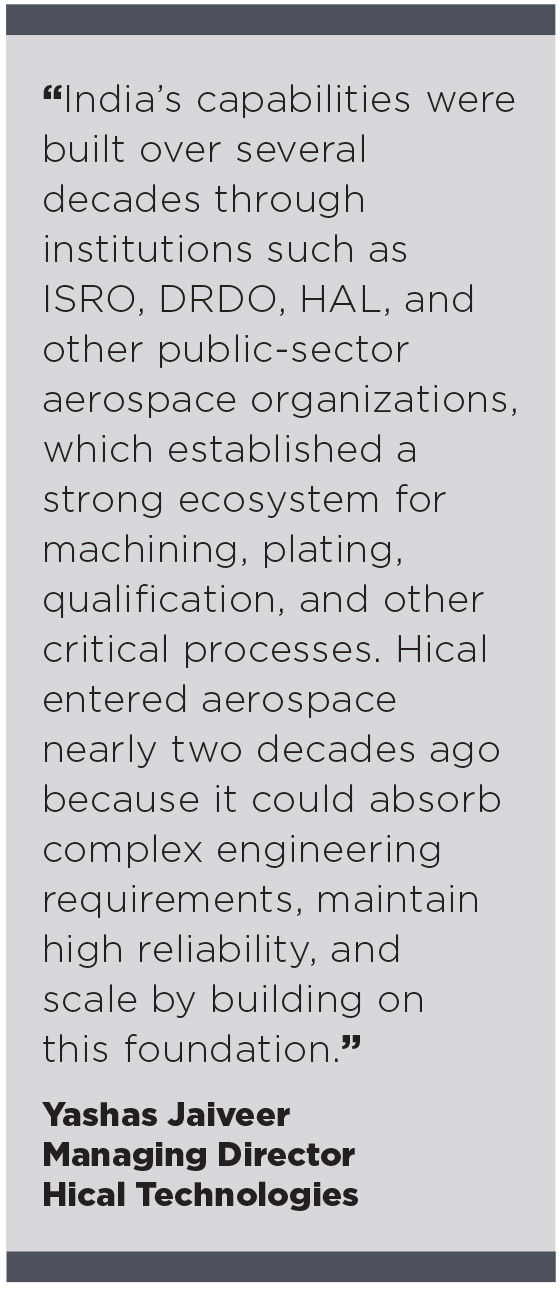
Hical’s aerospace journey was not driven by a recent China+1 strategy. India’s capabilities were built over several decades through institutions such as ISRO, DRDO, HAL, and other public-sector aerospace organizations, which established a strong ecosystem for machining, plating, qualification, and other critical processes. Private companies with strong engineering and quality cultures were then able to build on this foundation. Hical entered aerospace nearly two decades ago because it could absorb complex engineering requirements, maintain high reliability, and scale within this established ecosystem.
Today India is recognized as a credible, tier-1 manufacturing hub for complex, mission-critical systems. What were the critical capability milestones in terms of quality standards, IP protection, and certification ecosystems that Hical and the wider Indian industry had to reach to earn this deep global trust?
India earned global trust by consistently meeting demanding standards — AS9100, ISO requirements, Nadcap special-process approvals, clean-room assembly requirements, and customer-specific quality systems. Tools such as APQP (Advanced Product Quality Planning) ensure that quality, manufacturability, and risk mitigation are addressed during engineering and new-product introduction, rather than after production begins.
At Hical, this capability was developed systematically across nearly 600 part numbers, supported by zero-defect performance, strong on-time delivery, and global supplier recognitions. Equally important has been Hical’s consistent record of integrity, ethical conduct, and protection of customer intellectual property.
 The regulatory landscape in Indian defence procurement emphasizes offsets and transfer-of-technology (ToT). Rather than treating offsets as a mere transactional compliance check, how is Hical leveraging these frameworks to forge deeper international co-development partnerships that bring true, proprietary aerospace design and manufacturing capabilities to Indian shores?
Global aerospace companies increasingly select Indian partners not only because of offset obligations, but because of proven quality, delivery, engineering capability, and IP protection. The next phase will move beyond component manufacturing towards complete systems, built-to-specification products, and higher-value engineering partnerships.
Offsets are seen as platforms for long-term partnerships, joint ventures, co-development, and the creation of proprietary design and manufacturing capabilities in India.
From a leadership and operational standpoint, how do you cultivate a ‘zero-defect’ culture across a scaling workforce when the precision requirements leave absolutely no room for error?
A zero-defect culture begins with leadership commitment and extends to every person involved in operations. The recruitment process must identify individuals who understand the seriousness of flight-safety-critical manufacturing, followed by continuous training in AS9100, Nadcap, and customer-specific requirements.
Employees must have the authority to stop production when a potential defect is identified. Chronic issues are addressed through cross-functional root-cause analysis and permanent corrective action. Independent quality representatives act as the customer’s voice on the inside, ensuring no product is released without full compliance.
How has Hical developed its cross-disciplinary engineering capabilities to design and manufacture components that must withstand extreme thermal, gravitational, and electromagnetic stress without sacrificing performance?
Hical combines mechanical, electrical, electromagnetic, materials, and manufacturing engineering expertise to develop products for demanding aerospace and space environments. These products undergo rigorous qualification for thermal, vibration, gravitational, and electromagnetic conditions.
For applications such as satellite scanning and positioning systems, designs may require lightweight construction, high reliability, and multiple levels of redundancy. In-house qualification capabilities allow engineers to validate materials, designs, and performance through extensive testing and iterative development.
Precision engineering in defence and aerospace is increasingly becoming a battle of materials science, working with exotic alloys, advanced composites, and strict lightweighting requirements. What are the key manufacturing and machining technologies Hical has invested in to stay ahead of these evolving material specifications?
Aerospace and defence products frequently require titanium, Inconel, aluminum, special alloys, and specialized grades of stainless steel — all procured from approved sources and processed through tightly controlled, fully traceable manufacturing routes.
The approach combines precision machining, advanced metrology, process validation, fabrication, and qualified special processes. Since materials and sources cannot be changed without customer approval and requalification, strict configuration control and process discipline are as important as the machining technology itself.
Having spent nearly 16 years in Hical, you are now driving its next major phase of growth as Managing Director. Executive leadership looks very different as a company scales than it does during the foundational years. What are your primary strategic imperatives for the company over the next 3 to 5 years, and how are you structuring the organization to absorb much larger global contract volumes?
Hical has three principal priorities. The first is operational excellence — maintaining zero-defect quality and on-time delivery as more than 500 qualified First Article Inspections transition into higher-volume production.
The second is capacity and vertical integration. New facilities in Devanahalli and Hosur will expand systems integration, precision machining, fabrication, and Nadcap-approved special-process capabilities.
The third is design and R&D. The company intends to expand its design organization significantly and invest in advanced engineering software and technologies, enabling a much larger portfolio of built-to-specification electromechanical products and systems.
In an intensely competitive market for engineers, what is your strategy for attracting, upskilling, and retaining the next generation of aerospace manufacturing leaders within India?
The strategy is to offer engineers more than a conventional manufacturing career — the opportunity to work on mission-critical global aerospace, defence, and space programs and see the direct impact of their work.
Hical will strengthen partnerships with universities, engineering colleges, and technical institutes in and around Bengaluru, supported by internships, apprenticeships, and structured graduate programs. Employees will receive cross-functional exposure, technical certification, mentorship, and clearly defined career paths. Retention will be driven by continuous learning, merit-based growth, leadership opportunities, and the pride of developing complex products in India for global platforms.
When global prime contractors think of mission-critical systems a decade from now, what specific space do you intend for Hical to occupy?
Over the next decade, the ambition is to become a globally significant supplier of complete electromechanical and hydraulic systems for commercial aircraft, business jets, fighter aircraft, defence, and space platforms.
 |
SOUMI MITRA |
 Facebook
.png) Twitter
Twitter Linkedin
 Subscribe