
STREAMLINING LONG-PROFILE MACHINING
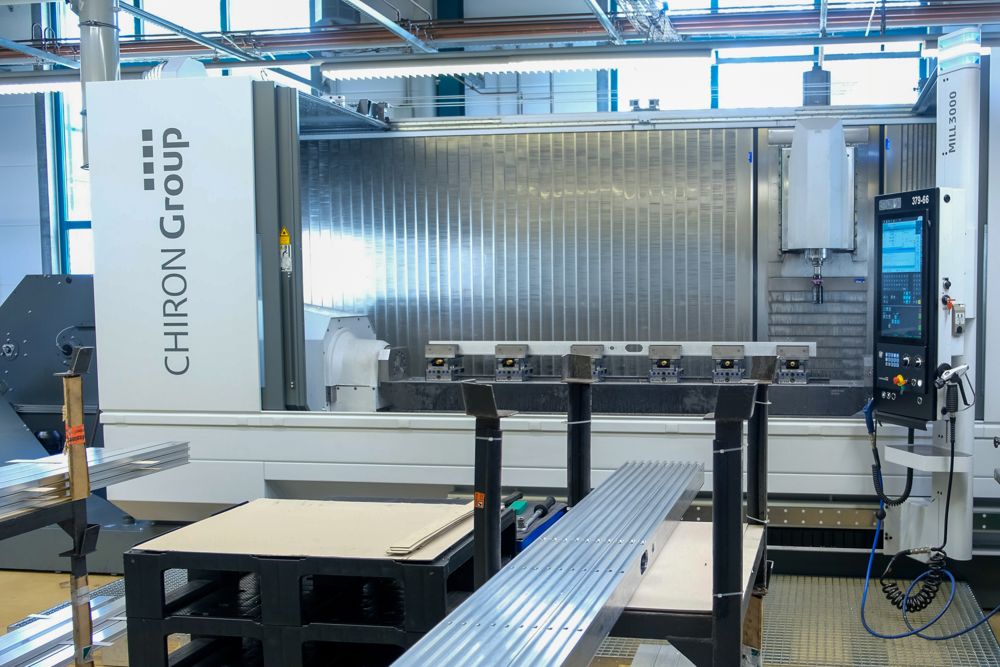
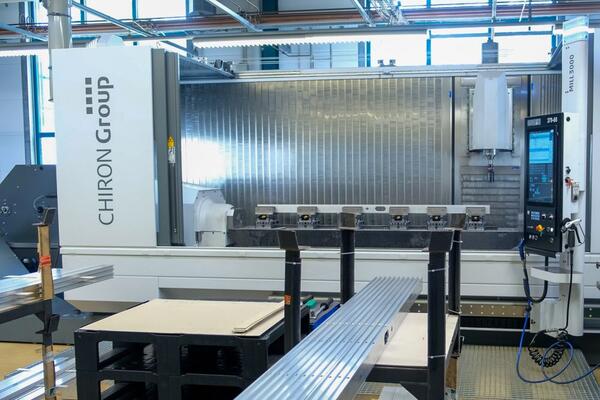
Dowaldwerke has expanded its machining capabilities for long aluminum profiles with a CHIRON MILL 3000 machining center. The solution enables more operations to be completed in a single clamping, reducing repositioning, setup time, and non-productive operations while improving process efficiency.
Dowaldwerke GmbH has once again opted for a machining center from the CHIRON Group for processing aluminum profiles. With a MILL 3000, the company is expanding its production of long hollow sections. The new machine offers technical advantages such as fewer clamping points, easier handling, and reduced non-productive times, while the established cooperation with CHIRON Group and employees’ positive experience with the existing solution also supported the decision.
Both the existing MILL 2000 and the new MILL 3000 are used primarily for producing aluminum profiles and tread plates for rail vehicles. Typical workpieces include profiles for interior door systems, boarding aids, bridging platform edges, and other railway technology components. The machining operations include drilling, contour and edge milling, as well as lateral machining. Many of these hollow aluminum sections are more than two meters long, and machining such long components with the existing production solution required additional time and manpower.
The company was therefore looking for a more efficient solution for machining these components. At the same time, it decided to expand its in-house production. “Since external providers could not meet our requirements for either precision or machining travel, it was clear to us that we would bring this production in-house, using a solution that could machine long workpieces economically while meeting our requirements for quality and productivity,” says Rico Eißler, Managing Director, Dowaldwerke GmbH.
Dowaldwerke: Partner for Railway Technology and Hydraulics
Dowaldwerke GmbH, based in Dippoldiswalde in Saxony, is part of the Richard Grießbach Holding group of companies with around 350 employees. In the field of railway technology, the portfolio includes vacuum toilets, interior door systems, partition walls, and boarding aids for well-known European manufacturers of rail vehicles. In the field of hydraulics, the company mainly manufactures hydraulic cylinders for agricultural and construction machinery as well as other vehicles.
Dowaldwerke has been using a MILL 2000 machining center for processing aluminum profiles for several years. According to Eißler, the machine has proved reliable in daily production. He also values the partnership with CHIRON Group, which is based on close cooperation and a shared focus on developing the right solution for each machining requirement.
When investing in new manufacturing solutions, Dowaldwerke involves the future users in the decision-making process. The milling specialists are responsible for programming, setting up, and processing their workpieces, making ease of operation and efficient workflows important considerations. For Cutting Machine Operator Lisa-Marie Ganz, the MILL 3000 emerged as a suitable solution for the long profiles: “We were already familiar with the machine concept and its operation and had good experience with it.”
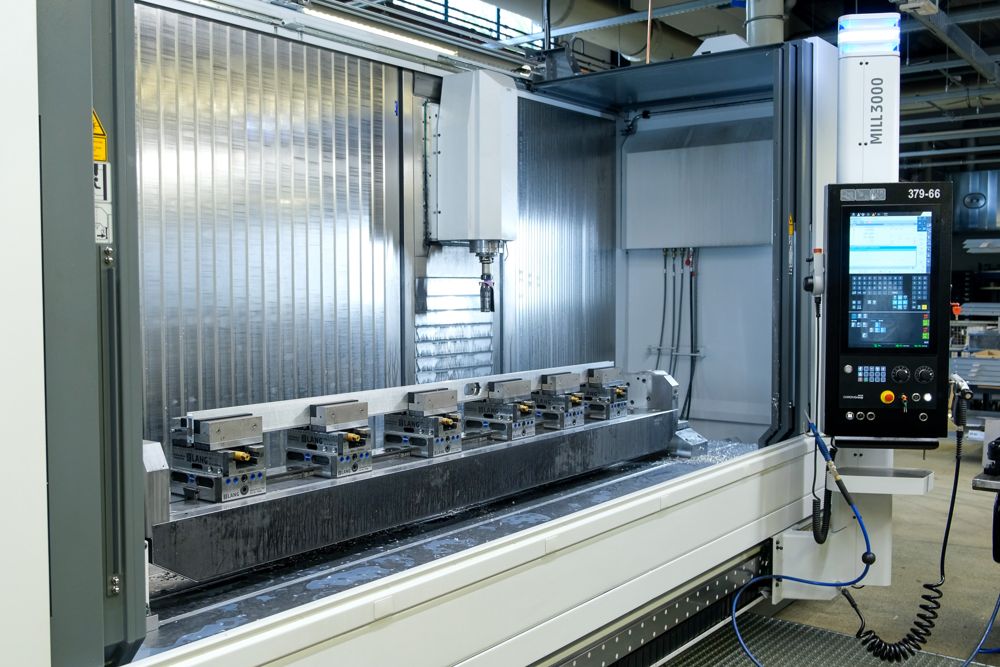
| The individually designed swing bridge enables lateral machining without reclamping and reduces the number of reference points required. |
Tailor-made Concept for Long Profiles
Together with the Dowaldwerke team, the CHIRON Group developed a manufacturing concept based on a milling center from the MILL Series. The machines are characterized by high cutting performance and, depending on the variant, cover workpiece lengths of 800 mm to 8,000 mm. Large, flexible working spaces allow for the machining of larger workpieces or multiple clamping, while high dynamics, powerful drives, fast setup, and ease of operation support efficient production across different part variants.
“The challenge was to machine the workpieces in one clamping if possible. This required a precisely coordinated production concept that offers sufficient flexibility for the various profile types and geometries,” explains Frank Scheibe, Technical Consulting and Sales, CHIRON Group.
The goal was to consistently reduce the number of clamping processes and reference points and to map different profile variants on a uniform production platform. The individually designed swing bridge makes a significant contribution to this.
The Fourth Axis Makes All the Difference
A key element of the production concept is the swivel bridge, which functions as an attached fourth axis. It allows the workpiece to be swivelled by 90 degrees, enabling lateral machining without reclamping. This improves process efficiency by reducing both the number of clamping operations and reference points. “Thanks to the swivel function, we can carry out many machining operations directly on the workpiece without reclamping. This simplifies the process and saves time in production,” adds Ganz.
The clamping technology provides another advantage. A single clamping jaw is sufficient for complete machining of a profile, while machining between the clamping devices is also possible. This reduces setup effort, simplifies the handling of long profiles, and improves process reliability.
Short tool-change times were another advantage for David Steinigen, Head of Work Preparation, Dowaldwerke. “We have a lot of tool changes and thus have a clear advantage in the program sequence. We can change tools as often as we like without it having to take up a lot of time.”
Building on a Strong Partnership
In addition to the technical capabilities of the MILL 3000 and the customized production concept, Dowaldwerke also placed importance on its longstanding cooperation with the CHIRON Group.
“Why did we choose a CHIRON Group machine again? Ultimately, beyond the quality of the machining centers, it is the cooperation that matters. The team is very cooperative and solution-oriented,” sums up Eißler.
Source: CHIRON Group SE
 Facebook
.png) Twitter
 Linkedin
 Subscribe