

WHAT GOOGLE LEARNED ABOUT BUILDING GREAT TEAMS

What makes a great team? Google set out to find the answer through Project Aristotle, studying more than 180 teams. The findings were surprising: high-performing teams were not necessarily made up of the smartest people, but of people who worked together in the right environment — one built on trust, clarity, purpose, and psychological safety.
Every engineering company wants better teams and hence spend a lot of time hiring capable engineers. They invest in expensive CNC machines, automation, ERP systems, and training programs. Yet many struggle with missed deadlines, quality issues, communication gaps, endless firefighting, and people blaming each other.
To find out why some teams consistently outperformed others, Google launched a research project called Project Aristotle in 2012. Researchers studied more than 180 teams over several years. They looked at educational qualifications, personality types, seniority, management styles, and even whether team members socialized outside work.
The conclusion surprised them.
The study found that the best teams were not built by collecting the smartest or those with the best qualifications. The best teams were built by creating the right environment for ordinary people to do their best work.
For engineering companies, that lesson is worth paying attention to. Designing a new machine, launching a production line, or solving a customer problem rarely depends on one brilliant engineer. Success usually comes from several departments working together, often under tight deadlines.
Google identified five characteristics that appeared repeatedly in its highest-performing teams.
Psychological Safety
This was the biggest finding — people performed better when they felt safe to speak up.
That sounds simple, but it is surprisingly rare. Every company has seen situations where a young engineer notices a problem in a design but keeps quiet because everyone else in the room is more senior. Sometimes an assembly line worker spots an issue long before anyone in management does, but decides it isn’t worth saying anything.
Those moments are expensive.
Harvard professor Amy Edmondson defines psychological safety as the confidence that people can ask questions, admit mistakes, and challenge ideas without being embarrassed or punished.
Deepa Agarwal, Founder and Chief Inclusion Officer, Re-Link, says, “People often think that psychological safety is a bit abstract and difficult to measure. In reality, it can be assessed by simply noticing the behavioral signals of every team member across multiple parameters, such as whether someone shares ideas or perspectives only when asked, does not ask questions or seek guidance out of fear, does not voice disagreement openly, or tends to keep interactions work-related, even when there are opportunities to build connections. Chances are that their psychological safety may be lower.”
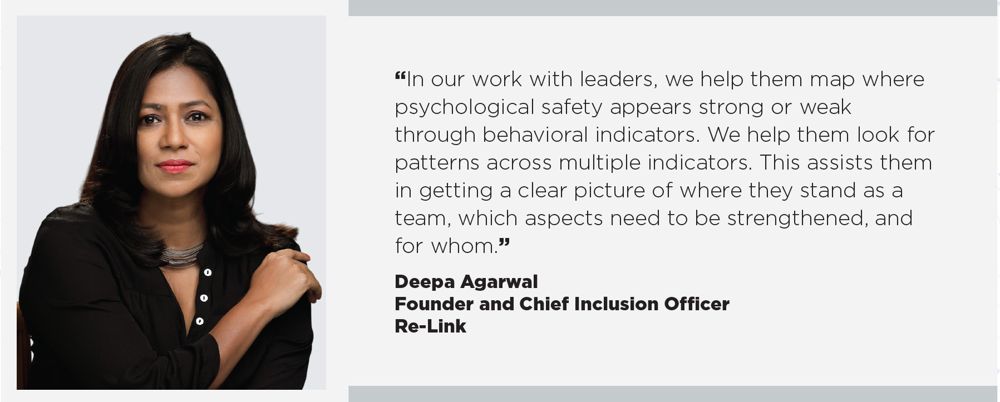
She adds, “In our work with leaders, we help them map where psychological safety appears strong or weak through behavioral indicators. We help them look for patterns across multiple indicators. This assists them in getting a clear picture of where they stand as a team, which aspects need to be strengthened, and for whom.”
“As an example, in one team, the leader identified that the safety score was lowest when it came to sharing opposing views. This made the leader reflect upon how easily they dismiss other people’s ideas if those ideas did not fit into their mental model. This was causing the team to be less innovative. This was followed up with the leader going through a program on developing a growth mindset,” she adds further.
Dependability
Every manufacturing company depends on trust. Production trusts purchasing to get materials on time. Quality trusts production to follow the process. Sales trusts engineering to deliver what has been promised to the customer.
When that trust breaks down, everyone starts checking everyone else’s work. Meetings become longer. Emails become longer. Progress becomes slower.
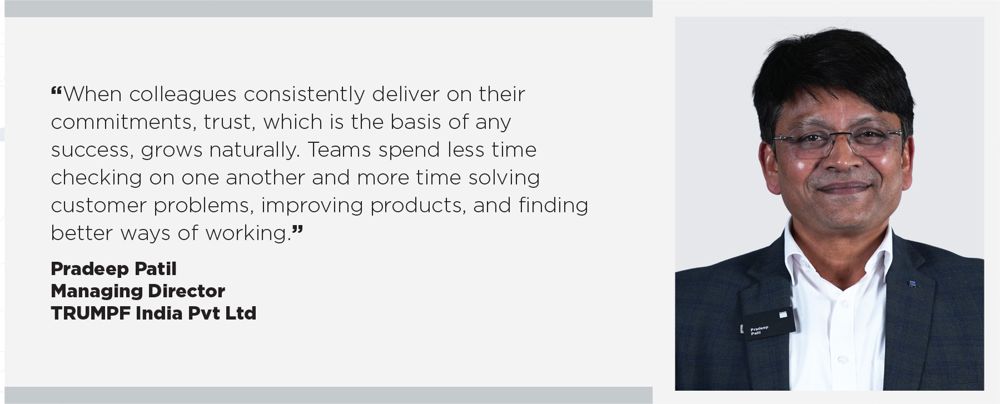
Pradeep Patil, Managing Director, TRUMPF India Pvt Ltd, says, “When colleagues consistently deliver on their commitments, trust, which is the basis of any success, grows naturally. Teams spend less time checking on one another and more time solving customer problems, improving products, and finding better ways of working. In my experience, dependable people are the foundation of dependable organizations.”
Structure and Clarity
Good engineers enjoy solving difficult technical problems. They should not have to spend half the day figuring out who is responsible for what.
Google found that successful teams had clear goals and well-defined roles. Everyone understood what success looked like.
In manufacturing, confusion is expensive.
Clear responsibilities save an enormous amount of time.
Patil says, “People do their best work when they know exactly what they’re trying to achieve and how they contribute to the bigger picture. When goals are clearly defined and responsibilities are well understood, teams can make decisions quickly like any entrepreneur, support one another, and stay focused on delivering results. Good leadership is often about providing that clarity, psychological safety, and then trusting people to do their jobs.”
Meaning
Engineers like solving problems. That is one reason many engineers entered the profession in the first place. But people also want to know that their work matters.
Agarwal says, “An important aspect for a team to be effective is having a shared vision. When all the individuals on the team attach a personal meaning and share the same parameters for
what success looks like, they are more likely to collaborate and look beyond their personal prejudices and biases to accomplish the goal. Leaders play a critical, facilitative role in helping their teams draw value and connect to a shared sense of purpose.”
Impact
The final characteristic was impact. People want to see that their work makes a difference.
Most factories already measure productivity, rejection rates, delivery performance, and machine utilization. Those numbers are important.
What often gets overlooked is telling the people behind those improvements that they made them happen. A simple conversation saying, “Your idea really made a difference,” can have far more impact than a motivational speech. People remember knowing that their work mattered.
A Lesson for Indian Manufacturing
Indian manufacturing has become remarkably sophisticated over the last decade. Today, Indian companies supply precision components to the aerospace, automotive, electronics, medical devices, and semiconductor industries around the world. Indian factories increasingly match global standards in technology.
The next challenge is people.
Many organizations still have cultures where junior engineers hesitate to question senior managers. In some meetings, the highest-ranking person speaks first and everyone else nods politely.
That approach can hide problems and bury good ideas. The people closest to the problem often know where the real improvements lie.
Building Better Teams
The encouraging part about Google’s research is that none of these five characteristics requires huge budgets. They cost very little.
Listening costs nothing.
Giving people the confidence to ask questions costs nothing.
Clarifying responsibilities costs nothing.
Telling someone that their work made a real difference costs nothing.
Factories invest crores in new equipment every year. Those investments are essential. But the biggest improvement may come from something much simpler — creating a workplace where people trust one another, speak honestly and work together with a shared purpose.
Machines improve productivity. People improve companies.
 |
REJI VARGHESE |
 Facebook
.png) Twitter
Twitter Linkedin
 Subscribe