
GrindingHub 2026: The Future of Intelligent Grinding
Frankfurt am Main, Germany – Fully automated, data-driven, precise: Artificial intelligence, sensor technology, and smart production control are turning grinding machines into intelligent manufacturing partners today. This results in productive, flexible, and self-optimizing systems. GrindingHub 2026 will bring together the industry’s ‘who's who’ in Stuttgart from May 5 to 8 to engage in direct dialog with trade visitors and present pioneering high-tech solutions. From unmanned closed-loop manufacturing, stream finishing, and automated compensation to grinding for humanoid robot components, sensor technology, and AI for stable precision processes, there are numerous highlights to discover.
Redefining the Standard for Grinding
“With intelligent automation 4.0, we have long since heralded the change,” reports Marie-Sophie Maier, Managing Director, Adelbert Haas GmbH - Trossingen. “Intelligent, fully automated complete manufacturing has overtaken traditional complete machining. Today, extremely high productivity and flexibility are essential, as is zero compromise on precision. Turnkey grinding? That’s no longer enough. We are in demand as a partner who has mastered end-to-end digitalization and automation and is putting this into practice!” Fully automated closed-loop manufacturing is standard at Adelbert Haas. Grinding, measuring, grinding—to perfection: 21 shifts per week, unmanned, efficient.
And service? “Service is not a reaction, but prevention. Our Customer Care Center solves problems before they arise. AI agents analyze machine data in real time, detect anomalies, and initiate measures before a shutdown threatens: automatic ticket creation, prioritization of critical alarms, and log files at the touch of a button. Rule-based programming is a thing of the past. Today, we learn from data and act proactively,” adds Marie-Sophie Maier. “This makes customer service an attitude and a real competitive advantage. GrindingHub 2026 in Stuttgart offers the ideal platform to discuss these developments: How grinding technologies benefit from automation and AI, and how solutions from Adelbert Haas will shape the future of manufacturing.”
Step by Step, Everything Right From the Start
“At GrindingHub, in addition to presenting new products for stream finishing and the manufacture of indexable inserts and microtools, we will be focusing on automation and production control,” reveals Martin Winterstein, Managing Director, Anca Europe GmbH - Weinheim. “The goal is to help users manufacture competitively under their given conditions through high quality, low manufacturing costs, and creative solutions.”
As an example of this, Anca, headquartered in Melbourne, Australia, presents a server-based system for digital production control, including app-based worker guidance and automated measurement and compensation. Similar to a traffic controller for tool production, the system ‘tells’ each pallet and each machine what to do next for each order and gives the operating personnel step-by-step instructions so that everything is done correctly the first time. It builds on existing Anca and Zoller machines, allowing operators to continue using the hardware they are familiar with—but the entire workflow is organized, digitized, and seamlessly traceable.
For operators, the biggest change is that the necessary work steps are described clearly and unambiguously. Digital work instructions on a PC or portable device show which pallet is to be loaded, which program is already prepared on the grinding machine, when measurements need to be taken, and how to respond to the measurement results. This eliminates time-consuming file searches, avoids most manual data entry, and makes compensation and quality checks significantly easier and more reliable.
A closed measurement loop and automatic compensation ensure that batches remain within tolerance without the operator having to calculate or remember offsets. At the same time, all data is stored centrally so that every step can be traced. The result: A skilled worker can independently oversee a larger number of machines than before, new employees are trained more quickly, waste is reduced, and the entire shift runs more smoothly and predictably.
High-precision Grinding for the Future of Humanoid Robots
Transmission elements in humanoid robotics are mechanical components that transmit movements and forces from a drive to a joint or other moving parts. They are crucial for the efficiency, precision, and dynamics of movements. Linear and rotary drives are combined in complex robotic systems, for example, rotary drives in hips and shoulders and linear drives in fingers, arms, and legs. The manufacture of these components requires grinding processes that ensure the necessary dimensional accuracy and surface quality in order to meet precision requirements and keep noise emissions to a minimum.
“Our grinding machines guarantee high dimensional and geometrical accuracy, process reliability, and flexibility with high output. Thanks to our many years of experience in thread grinding, we are able to offer customized grinding solutions for all types of threads,” explains Jan Schmid, Head, Engineering & Project Planning, Erwin Junker Maschinenfabrik GmbH - Nordrach. “Our expertise guarantees maximum precision and quality—even for complex requirements.”
For machining key components for humanoid robots—such as joints and drives—the Black Forest-based company offers specialized grinding solutions with ceramic and electroplated CBN grinding wheels and grinding pins: In ‘internal thread grinding’, threads are ground directly from solid material. Cone and ball threads as well as special profiles can be manufactured with precision. Even the smallest internal thread diameters, smaller than 10 mm, can be machined reliably. In addition, nuts with an unfavorable diameter/length ratio can be machined without any problems.
“When grinding threaded spindles, even threads with high pitch angles can be produced thanks to the flexible machine concept,” explains Schmid. In addition to cone and ball threads, we manufacture custom profiles that are precisely tailored to customer requirements. For maximum flexibility, we offer solutions for single-tooth machining and multi-tooth machining for particularly high output.”
When ‘grinding thread rolls’, the entire machining process is carried out in a precise and efficient manner. “The external geometry, thread, and gear teeth are manufactured in a single clamping process. Come and see our grinding solutions for yourself at GrindingHub in Stuttgart,” announces Schmid.
Smart Grinding: Sensors and AI for Stable Precision Processes
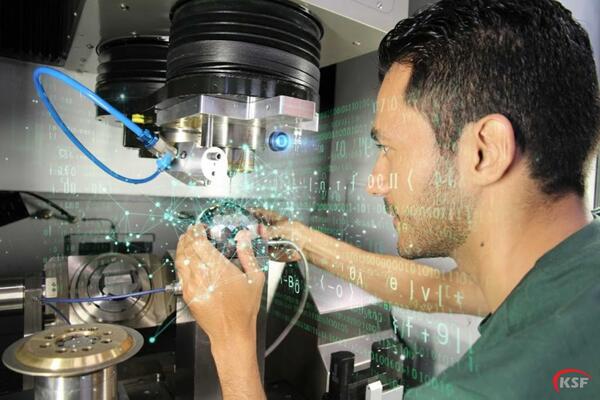
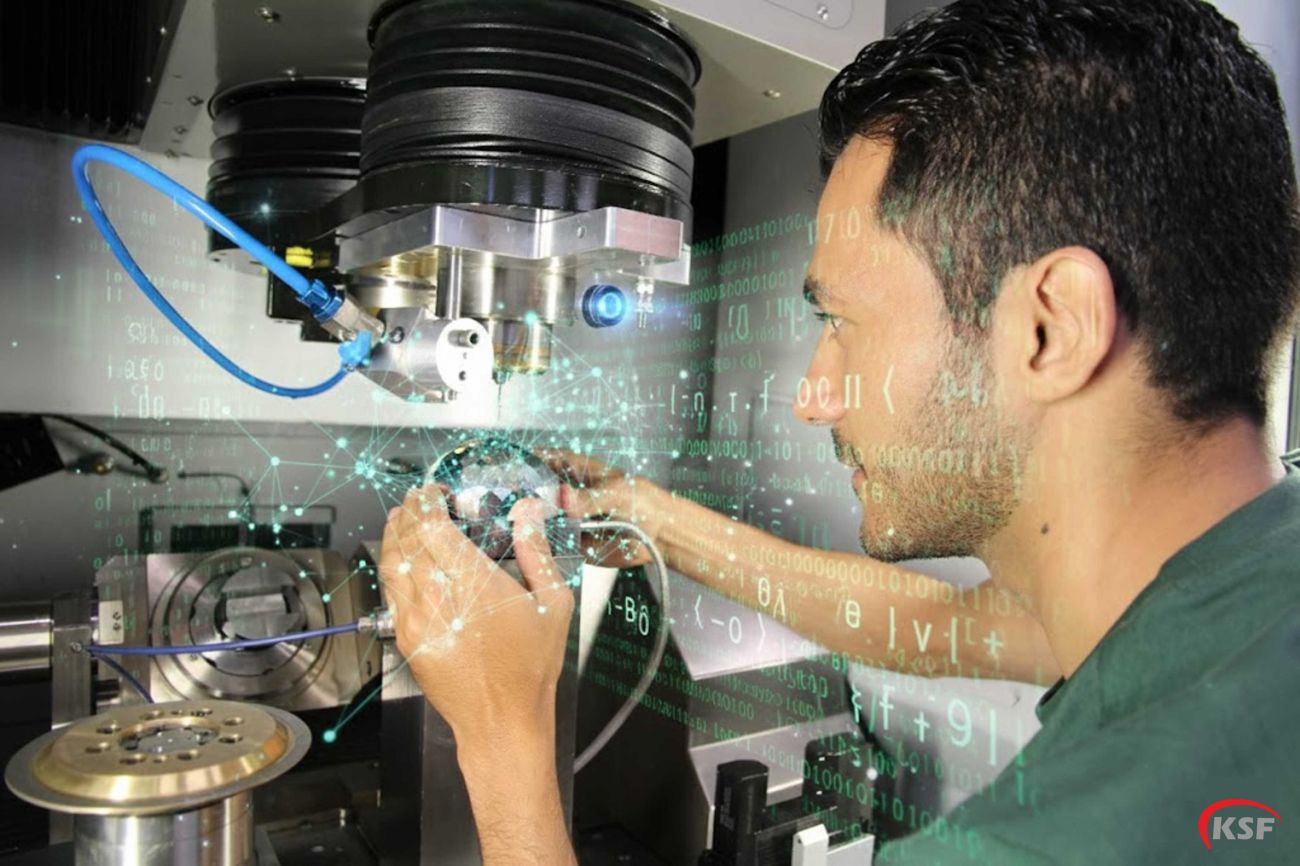
“Current developments in precision grinding show a clear trend toward integrated, closed control loops at the machine and process level. Modern machine tools combine classic NC and path controls with real-time sensor monitoring, integrated in-situ measurement technology, and increasingly also with additional measuring cells directly next to the machine, for example with coordinate measuring systems,” reports Prof Bahman Azarhoushang, Head - KSF Institute, Furtwangen University. The goal is to significantly increase process efficiency and productivity without compromising on dimensional and geometrical accuracy or surface quality.
Integrated sensor packages continuously generate process data. Examples of this include force and vibration sensors, as well as sensors installed in drive technology to monitor current and voltage, for example, in the spindle. This data is used by AI models to predict wear on the grinding wheel or to detect unstable process conditions (anomaly detection). In addition, it can be used to predict component quality for automatic optimization of cutting parameters, such as feed rate, cutting speed, or infeed. This data also forms a central ‘process database’ in which process-related expertise is stored and continuously enriched. This gives companies the opportunity to build up internal process knowledge in the long term and keep it available despite the shortage of skilled workers—regardless of the individual experience of individual employees.
“Modern intelligent grinding machines integrate particularly dynamic drives, high-resolution measuring chains, and adaptive control algorithms that continuously analyze and autonomously optimize the grinding process,” explains the Head of the KSF Institute (Institute for Advanced Manufacturing) at the Innovation and Research Center IFC in Tuttlingen. “In my opinion, intelligent grinding technologies represent a decisive step toward robust, self-optimizing manufacturing systems. The combination of sensor technology, integrated measurement technology, and AI-supported process control enables more sustainable, economical, and at the same time more consistent quality precision machining.”
The main challenge lies in the complete integration of these technologies into existing production environments, both from a technical and organizational perspective. “Looking at GrindingHub, it becomes clear: The future competitiveness of industrial manufacturing locations depends largely on how consistently grinding processes are digitized, automated, and operated in closed control loops,” concludes Prof Azarhoushang. “Intelligent machine tools and artificial intelligence will play a key role in this.”
Grinding Reimagined
Both suppliers and users are facing unprecedented challenges, and precision grinding is also undergoing fundamental change. Automation, end-to-end digitalization, and AI-supported control loops transform traditional grinding processes into highly productive, self-optimizing manufacturing systems. Fully automated closed-loop processes ensure quality, flexibility, and cost-effectiveness, even when requirements are particularly high. Sensors, intelligent production control, and data-based service are shifting the focus from reaction to prevention. GrindingHub 2026, held in the heart of Europe, will uniquely demonstrate how these technologies are shaping the competitiveness of industrial manufacturing in the long term.
Image Source: VDW (German Machine Tool Builders’ Association)
 Facebook
.png) Twitter
Twitter Linkedin
 Subscribe