

POWERING GROWTH IN FORGING INDUSTRY

Yash Munot, President, Association of Indian Forging Industry (AIFI), in the following conversation with MMI’s Editor-in-Chief Soumi Mitra, shares insights into the developments unfolding in India’s forging industry. He highlights the macro-trends driving growth in the domestic market and explains AIFI’s role in guiding the industry’s transition from traditional setups to highly automated smart factories.
With the domestic market projected to grow significantly by 2030, what macro-trends are driving this momentum, and how is the Association of Indian Forging Industry (AIFI) steering the industry to capitalize on emerging, high-value sectors like Aerospace, Defence, and EVs?
India’s Forging industry is entering a transformative growth phase driven by several macro trends such as rapid industrialization, increasing domestic manufacturing under the ‘Make in India’ initiative, rising demand from Automotive and Infrastructure sectors, and the strong push toward electric mobility and defence indigenization. At AIFI, we see significant opportunities emerging in high-value sectors such as Aerospace, Defence, and EV Components, where precision, lightweighting, and reliability are critical. Our role is to facilitate this transition by promoting advanced manufacturing practices, encouraging technology adoption, and enabling collaboration between industry, academia, and government. Through skill development initiatives, global partnerships, and technology forums, AIFI is actively preparing Indian forging companies to move up the value chain and become competitive suppliers in global high-performance component markets.
As the forging ecosystem transitions from traditional setups to highly automated smart factories, how is AIFI addressing the critical skills gap, and how can the next generation of leaders overcome legacy business models?
The transition toward automated and digitally integrated forging facilities requires a fundamentally new skill set that blends traditional metallurgical expertise with digital and data-driven manufacturing. At AIFI, we are actively addressing this challenge by collaborating with technical institutes, skill development bodies, and industry experts to design specialized training programs for the forging workforce. We also encourage exposure to Industry 4.0 technologies such as robotics, automation, and predictive analytics. For the next generation of leaders, the key lies in embracing innovation while respecting the strong operational foundation built over decades. Moving beyond legacy business models will require a shift toward data-led decision-making, global quality benchmarks, and strategic investments in technology that enhance productivity, traceability, and sustainability.
There is an accelerating demand for lightweight, high-strength components to support electric mobility and aerospace applications. From a technical and processing standpoint, how are Indian forging companies adapting their capabilities to work with advanced materials like titanium and complex aluminum alloys?
The shift toward electric mobility and aerospace applications has accelerated the need for lightweight yet high-strength components. Indian forging companies are increasingly investing in advanced forging technologies capable of processing materials such as titanium alloys and complex aluminium grades. These materials demand precise temperature control, specialized dies, and sophisticated process monitoring to maintain structural integrity and dimensional accuracy.
Many forging companies are upgrading their presses, adopting isothermal and precision forging techniques, and integrating simulation tools to optimize material flow and reduce defects. At AIFI, we are encouraging knowledge-sharing platforms and international collaborations so that Indian manufacturers can develop deeper expertise in advanced materials processing and position themselves as reliable suppliers for global aerospace and high-performance mobility ecosystems.
While large enterprises are rapidly adopting mechanization, a vast majority of India's forging industry still comprises MSMEs. How practical is the integration of AI-driven process optimization, IoT, and robotics for these smaller players, and what steps is AIFI taking to make digital transformation accessible to them?
MSMEs form the backbone of India’s forging ecosystem, and their participation in the digital transformation journey is essential for the sector’s long-term competitiveness. While the adoption of technologies such as AI-driven process optimization, IoT-enabled monitoring, and robotics may initially appear capital-intensive, scalable and modular solutions are making these technologies increasingly accessible to smaller manufacturers.
At AIFI, we are working to bridge this gap by organizing technology awareness programs, facilitating access to shared knowledge platforms, and promoting collaborative models where MSMEs can adopt digital tools in a phased and cost-effective manner. Our objective is to ensure that smaller forging units are not left behind but instead become agile, data-driven manufacturing partners within the broader supply chain.
Sustainability is becoming a strict mandate rather than a choice. With initiatives like circular forging and the integration of solar power gaining traction, what specific technical upgrades must forging plants implement to align with global ESG standards and reduce material waste?
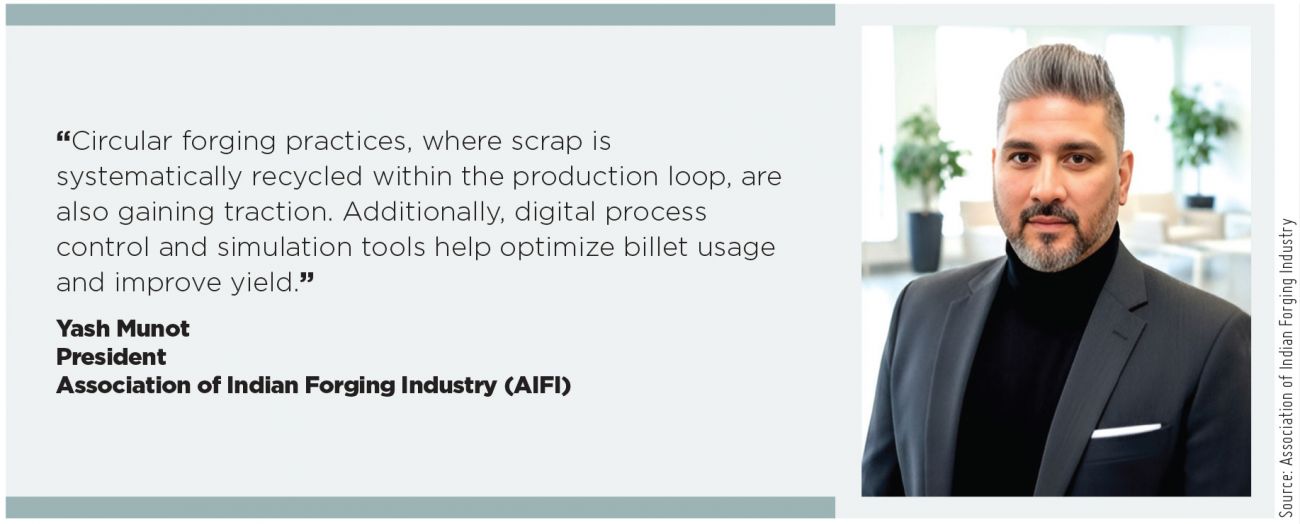
Sustainability has become a central priority for the Forging industry as global customers increasingly demand environmentally responsible manufacturing practices. Forging plants can significantly reduce their environmental footprint through several technical upgrades. These include adopting energy-efficient induction heating systems, integrating renewable energy sources such as solar power, and implementing advanced process monitoring to minimize material waste and rework. Circular forging practices, where scrap is systematically recycled within the production loop, are also gaining traction. Additionally, digital process control and simulation tools help optimize billet usage and improve yield. At AIFI, we are actively promoting best practices and knowledge exchange to help Indian forging companies align with global ESG standards while improving operational efficiency.
|
AIFI is actively addressing the skill gap challenge by collaborating with technical institutes, skill development bodies, and industry experts to design specialized training programs for the forging workforce. |
Forged components rely heavily on high-precision machining to meet tight global tolerances. How would you evaluate the current synergy between the Indian Forging industry and the domestic Machine Tool sector?
 |
|
Image Source: Association of Indian Forging Industry |
The relationship between the Forging industry and the Machine Tool sector is extremely critical, as forged components require high-precision machining to meet stringent global tolerances. Over the past decade, we have seen encouraging progress in the capabilities of Indian machine tool manufacturers, particularly in CNC machining centers and specialized tooling solutions. However, there is still scope for deeper collaboration between forging companies and machine tool builders to develop solutions tailored specifically for forged components. AIFI strongly advocates stronger industry linkages, joint research and development initiatives, and technology partnerships that can help both sectors grow together. A robust domestic machine tool ecosystem will ultimately strengthen India’s position as a competitive global manufacturing hub.
Are there specific technological advancements in multi-axis CNCs or metal-cutting machinery that forging companies urgently need from Indian builders?
As forging companies move toward higher precision and complex geometries, the demand for advanced machining solutions is increasing rapidly. In particular, multi-axis CNC machining centers with higher rigidity, faster tool change systems, and improved thermal stability are becoming essential for machining forged components with tight tolerances. Forging manufacturers also require machines capable of handling difficult-to-machine materials such as titanium and high-strength alloys.
|
The association sees significant opportunities emerging in high-value sectors such as Aerospace, Defence, and EV Components, where precision, lightweighting, and reliability are critical. |
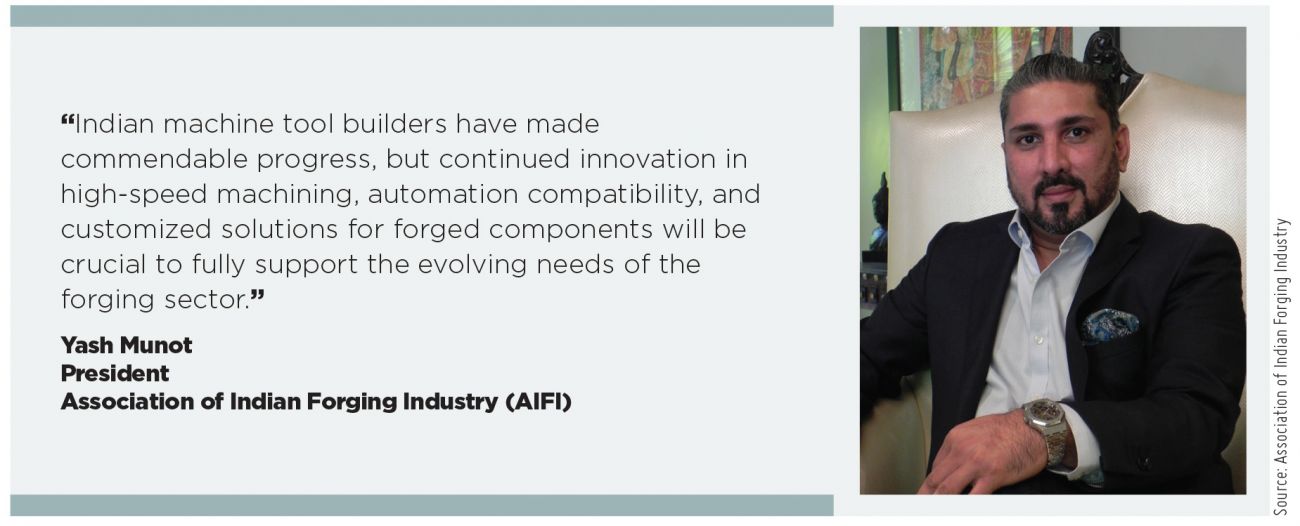
Additionally, integration with digital monitoring systems, predictive maintenance tools, and automated tool management will be critical in enhancing productivity. Indian machine tool builders have made commendable progress, but continued innovation in high-speed machining, automation compatibility, and customized solutions for forged components will be crucial to fully support the evolving needs of the Forging sector.
Die life, precision, and thermal resistance are critical points in closed-die forging. How are modern CAD/CAM software, forging simulation tools, and advanced die-sinking EDM machines transforming forging die design, and what impact is this having on overall production yield and defect reduction?
 |
|
Image Source: Association of Indian Forging Industry |
Advancements in digital engineering tools are significantly transforming the way forging dies are designed and manufactured. Modern CAD/CAM platforms, coupled with advanced forging simulation software, allow engineers to predict material flow, stress distribution, and potential defect zones even before physical production begins. This enables optimized die design, improved thermal management, and better material utilization. Additionally, high-precision die-sinking EDM machines have enhanced the accuracy and surface finish of complex die cavities, which directly influences the quality of forged components. These technologies collectively contribute to longer die life, reduced trial-and-error during production, and significantly lower defect rates. Ultimately, this results in improved production yield, better consistency, and enhanced competitiveness for Indian forging companies in global markets.
How can the integration of advanced machine tools and automated inspection systems help Indian manufacturers differentiate themselves through superior value-added solutions rather than just cost arbitrage?
For many years, Indian manufacturing gained global traction primarily through cost competitiveness. However, the future lies in delivering superior value through precision, reliability, and innovation. The integration of advanced machine tools with automated inspection systems such as coordinate measuring machines, laser scanning, and AI-enabled quality analytics allows manufacturers to achieve consistent accuracy and traceability across production batches.
|
AIFI is organizing technology awareness programs, facilitating access to shared knowledge platforms, and promoting collaborative models where MSMEs can adopt digital tools in a phased and cost-effective manner. |
This level of process control is particularly important for sectors such as Aerospace, Defence, and Electric Mobility, where component reliability is non-negotiable. By combining precision machining with real-time inspection and data-driven quality assurance, Indian forging companies can position themselves not merely as cost-efficient suppliers but as trusted partners capable of delivering high-value engineered solutions to global customers.
 |
SOUMI MITRA |
 Facebook
.png) Twitter
Twitter Linkedin
 Subscribe