
India–Japan Trade Climbs to US$ 27.5B as Manufacturing Ties Deepen
Rubix Data Sciences shares key insights from its latest analysis, ‘India–Japan Business Scenario’, released on the occasion of Japanese Prime Minister Sanae Takaichi’s upcoming three-day visit to India starting July 1, 2026, for the 16th India-Japan Annual Summit.
As India and Japan deepen their Special Strategic and Global Partnership — with a 10-year investment roadmap targeting US$ 67.56 billion in Japanese private investment, growing SME collaboration, and expanding cooperation in semiconductors, AI, and critical minerals — the report highlights a relationship marked by rising investment confidence and a manufacturing-led shift in trade, even as the trade deficit continues to widen.
Key insights from the analysis:
- Japan is India’s fifth-largest source of FDI equity inflows, with cumulative investments of approximately US$ 48 billion between January 2000 and March 2026.
- India has remained the most promising investment destination for Japanese companies for the fourth consecutive year, with 81.5 percent of Japanese firms planning to expand operations in India over the next 1-2 years.
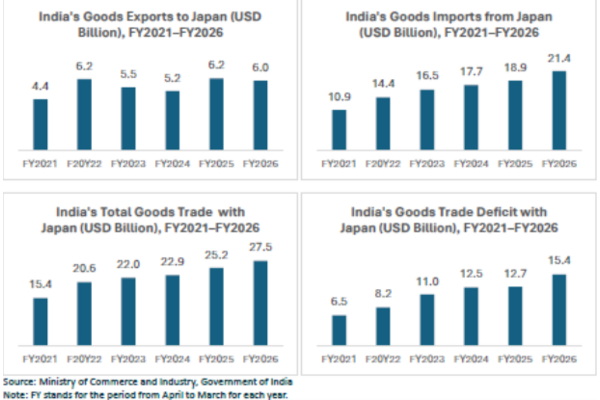
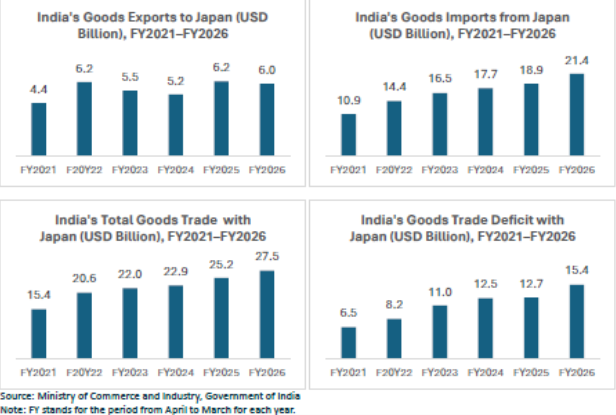
- India’s total goods trade with Japan grew from US$ 15.4 billion in FY2021 to US$ 27.5 billion in FY2026, a 12 percent CAGR, though the trade deficit widened from US$ 6.5 billion to US$ 15.4 billion over the same period.
- Automobiles emerged as India’s largest export growth driver, with their share of exports to Japan rising sharply from 1 percent in FY2021 to 13 percent in FY2026.
- Japan remains a key source of industrial inputs for India, led by refined copper and alloys (10 percent) and precious metals (9 percent) in FY2026, alongside rising imports of auto components and electronic integrated circuits (EICs).
Image Source: Rubix Data Sciences
 Facebook
.png) Twitter
Twitter Linkedin
 Subscribe